
BND Scope: Issue 15 - Shutdown Ended, Another Rate Cut Signal From Fed
November placed the U.S. economy at the intersection of three major forces: the data blackout caused by the historic government shutdown, the Federal Reserve’s clear signal that a December rate cut is now a strong possibility, and Washington’s use of tariffs as a deliberate tool to secure foreign investment. Meanwhile, tech giants announced massive AI and energy commitments, underscoring how the country’s long-term strategy is shifting toward next-generation infrastructure and industrial realignment.
BND SCOPE
11/15/20254 min read

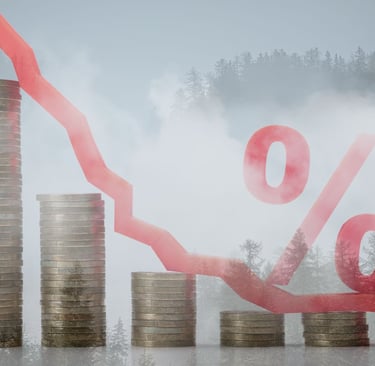
The historic government shutdown created a thick fog of uncertainty, leaving the Fed without the data it typically relies on. Yet even in this environment, the Federal Reserve made it clear that a December rate cut is now a strong policy option. Under normal circumstances, weeks of missing data would push the Fed toward caution. Instead, statements from Fed Governor Lisa Cook show that the central bank can no longer overlook the weakening labor market and tightening financial conditions.
Shutdown-driven uncertainty has pushed gold to new highs, and the Fed’s own financial stability assessment indicates that elevated market valuations may now be overshadowed by emerging slowdown risks. Cook’s comments—issued just before the shutdown ended—carry a clear message: even without fresh data, keeping monetary policy too tight for too long could be more damaging than easing prematurely.
These remarks also suggest that in the December meeting the Fed may not only adjust interest rates, but could be prepared to act proactively in other areas of policy if needed.
Conclusion
November revealed three defining realities for the U.S. economy. First, the shutdown-induced data blackout created both operational and psychological strain, complicating the Fed’s decision-making and undermining business planning. Second, the Fed’s strong signal toward a December rate cut showed that policymakers can no longer ignore the cooling momentum in the labor market and tightening financial conditions. Third, Washington’s tariff-for-investment strategy—combined with unprecedented AI and energy infrastructure commitments—clarified the long-term direction of U.S. economic policy: a shift toward industrial re-anchoring and large-scale technological build-out.
Together, these dynamics made November a month that exposed immediate risks while illuminating the deeper structural transformation underway in the American economy.
The political standoff in Washington triggered the longest federal government shutdown in U.S. history, creating silent but far-reaching economic damage. Lasting more than 40 days, the shutdown left 1.25 million federal workers unpaid, weakened consumer spending, caused over 7,500 flight cancellations, and inflicted billions of dollars in losses on the travel and services sectors. The Congressional Budget Office summarized the situation bluntly: U.S. growth may fall by 1.5 percentage points, and part of that loss may never be recovered.
Although the shutdown formally ended on day 43, contentious provisions added to the funding bill signal that political tensions may intensify heading into the 2026 elections—meaning the risk of future shutdowns is far from gone.
In the absence of official data, investors turned to private sources such as Revelio Labs; however, these “backup” datasets are more volatile and far less reliable for policy decisions. Revelio’s estimate of 9,100 job losses in October points to a cooling economy, but without official readings from the U.S. Bureau of Labor Statistics (BLS), the true picture remains incomplete.
As the shutdown dragged on, the problem extended beyond missing numbers: businesses faced planning paralysis, delayed decisions, and heightened uncertainty—now one of the most serious threats to the U.S. economy.
At BND Consulting, we’re here to support your investment decisions with insight, clarity, and strategy. Reach out to us any time—we’re ready when you are.

November proved to be a month in which the U.S. economy moved along three distinct tracks at once. Front and center was the unprecedented federal government shutdown, which created a deep data blackout and widespread economic disruption. Within this fog, the Federal Reserve signaled that a December rate cut is now a strong possibility, suggesting a shift toward a more accommodative stance despite the scarcity of reliable data. At the same time, behind the headlines, Washington’s use of tariffs as a bargaining tool to extract large-scale foreign investment accelerated, while tech giants rolled out massive AI and energy-infrastructure commitments. Taken together, these developments made November a pivotal month—one that revealed both the short-term risks and the long-term transformation shaping the path of the U.S. economy.
Fed Signals a Potential Rate Cut
Shutdown Ends, but the Damage May Persist
A New Industrial Strategy: Tariffs as a Tool to Attract Investment
While the shutdown and data blackout dominated headlines, a far more strategic shift gained momentum beneath the surface. The Trump administration is now using tariffs not merely as protectionist measures, but as an explicit lever to extract foreign investment. The approach is straightforward—and intentionally forceful: raise tariffs first, then offer reductions in exchange for large-scale commitments to invest in the United States.
Three major developments in November show this strategy being executed systematically.
The most notable example is the U.S.–Switzerland agreement. Washington had raised average tariffs to 39%, and lowered them to 15% only after Switzerland pledged $200 billion in U.S. investment through 2028. These funds will flow into high-value sectors such as pharmaceuticals, biotech, gold refining, and rail equipment.
In parallel, CNH Industrial announced a $5 billion investment into its U.S. manufacturing and R&D operations, further anchoring its supply chain domestically. Meanwhile, U.S. Steel and Nippon Steel unveiled an $11 billion modernization plan to improve efficiency, reduce emissions, and enhance competitiveness across their facilities by 2028.
Collectively, these moves demonstrate a decisive shift: tariffs are no longer the chaotic tools of a trade war but the core of a deliberate industrial policy designed to pull production back onto U.S. soil. What began as a trend is now maturing into a structural and long-term strategy.
AI Giants Invest in Both Computing Power and Energy
Three major announcements from technology giants this month reveal that the United States sees AI infrastructure not just as a tech priority but as a national industrial strategy.
The sequence began on November 3, when OpenAI and Amazon announced a landmark agreement: OpenAI will purchase $38 billion worth of computing power from Amazon Web Services over the next seven years—reducing its reliance on Microsoft and reinforcing the country’s long-term investment cycle in AI capacity.
On November 11, Meta followed with a dramatic announcement: a $600 billion nationwide investment in next-generation data centers and AI-focused infrastructure, calling the program a “growth engine” for the entire country.
Then on November 12, Google secured an energy foundation for its expanding data-center footprint by signing a deal with TotalEnergies to purchase 1.5 TWh of solar power over 15 years from Ohio’s Montpelier solar facility.
Viewed chronologically, these developments form a coherent narrative: AI is no longer just about software or model training—it now requires the combination of massive computing power, sustainable energy, and domestic data infrastructure. Through these investments, the U.S. is signaling its intent to remain the central hub of the global AI economy.
Consulting
Join
info@bnd.consulting
+1 (346) 296 - 8588
© 2026. All rights reserved.

800 Bonaventure Way Ste 116 Sugar Land TX 77479